
Qualtech successfully conducted its webinar on June 18, 2026, providing participants with a practical overview of Australia TGA application pathways and the latest regulatory updates, alongside an introduction to New Zealand's medical device regulatory framework and effective market entry strategies. The session concluded with an interactive live Q&A session during which our expert speakers addressed questions directly from webinar participants.
1. TGA Applications - Overview on Medical Device Inclusion in Australia
Medical devices in Australia are categorized into 4 risk classes: Class I, Class IIa, Class IIb, and Class III. IVD products are classified separately from Class 1 to Class 4.
1.1. Stakeholders in Australia
- The Therapeutic Goods Administration (TGA) represents the government authority responsible for regulating medical devices and IVDs.
- The Manufacturer is responsible for determining device classification, intended purpose, and GMDN code, while ensuring compliance with the Essential Principles.
- The Sponsor imports and exports medical devices, registers medical devices on ARTG, and is responsible for post-market surveillance (PMS) obligations.
- The Agent is a person acting on behalf of the manufacturer or sponsor in relation to ARTG inclusion activities.
1.2. How to Apply for ARTG Inclusion
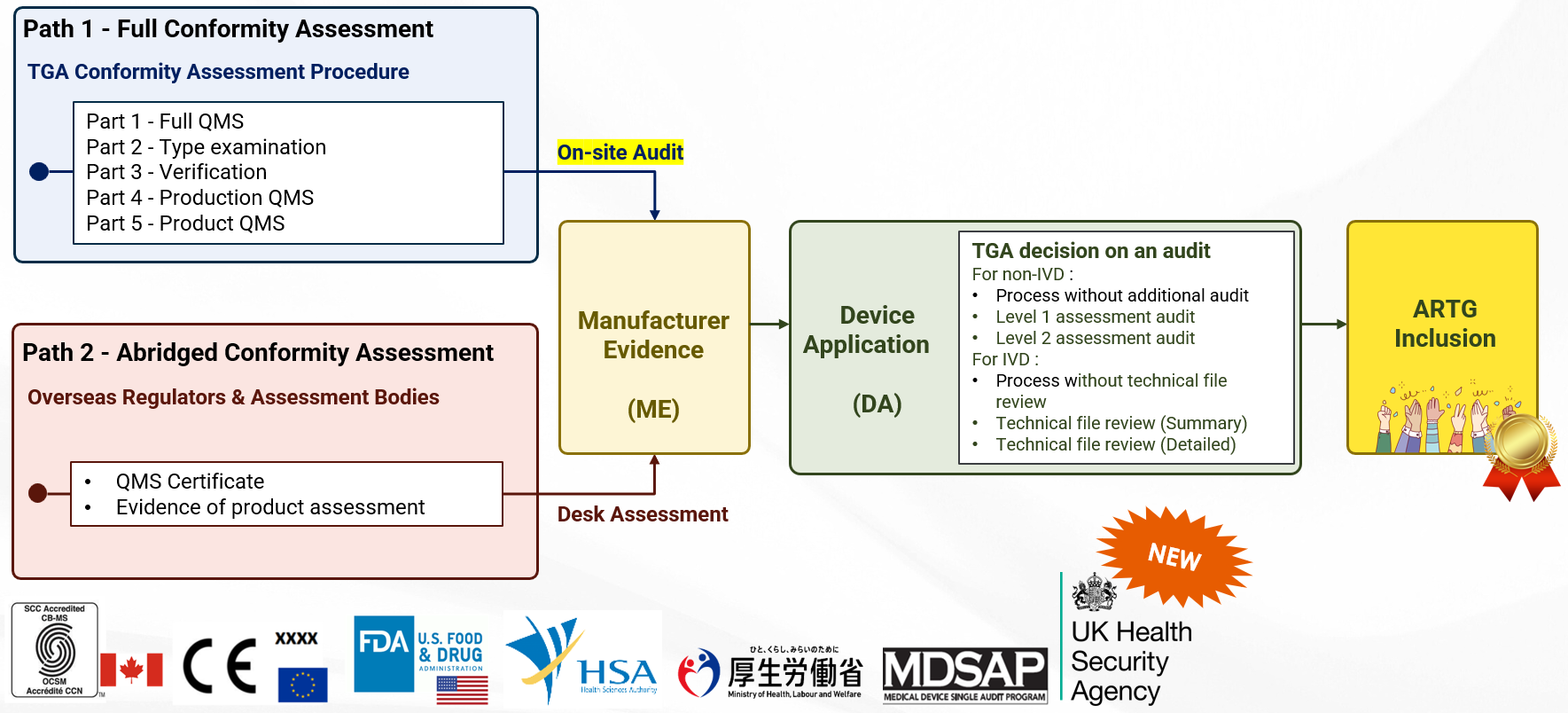
The inclusion process generally consists of 3 steps:
- Manufacturer Evidence: Submission of conformity assessment evidence, for which two different paths are available
- Device Application: Product Registration
- ARTG Inclusion: Premarket Approval
2. Post Market Obligations in Australia - PMS, Annual Charges, Recalls & Reports
Following ARTG Inclusion, manufacturers and sponsors must comply with several ongoing regulatory responsibilities as outlined below:
2.1. Post-Market Responsibilities of Manufacturers
- Ensure device conformity with the Essential Principles
- Post-market activities in Australia
- Inform the sponsor immediately of any changes to the device and/or the quality management system (QMS)
- Retain records for 5 years after the manufacturing of the last medical device
- All records including distribution records, complain records, or AE records must be available upon TGA's request
2.2. Post-Market Responsibilities of Sponsors
- Maintenance of active ARTG entries
- Report adverse events and coordinate recalls of medical devices
- In case of any changes, a conformity assessment certificate change notification becomes necessary
- Ensure compliance with the Therapeutic Goods Advertising Code
- Payment of annual charges to the TGA
2.3. Additional Regulatory Requirements
- If manufacturer evidence (ME) was obtained via CA certificate, it requires renewal every 5 years
- ARTG entries are subject to annual fees
- ME needs to be renewed. Its validity depends on the manufacturer's QMS certificate
- For Class IIb implantable and Class III devices: For the first 3 years after ARTG inclusion, annual reports must be submitted to confirm the absence of safety issues.
2.4. UDI Requirements
The TGA has introduced new Unique Device Identification (UDI) requirements in 2026, including:
- Inclusion of both Human Readable Interpretation (HRI) and Automatic Identification Data Capture (AIDC) information on the product label.
- Assignment of a different UDI at each level of packaging.
- Submission of UDI information to the Australian UDI Database (AusUDID).
Manufacturers should note that the implementation timelines are relatively short, particularly for class III and class IIb medical devices. UDI carriers must be placed on product labels and UDI-DIs/UDIs must already be submitted to AusUDID by July 1st, 2026. Lower-risk medical devices and IVDs benefit from later compliance deadlines.
3. New Zealand Applications - Overview on Medical Device Notification
Medical devices in New Zealand are regulated through the Web Assisted Notification of Devices (WAND) database, administered by the New Zealand Medicines and Medical Devices Safety Authority (MEDSAFE).
Medical devices are classified into 5 risk categories, consisting of Class I / Class I Sterile / Class I Measuring, Class IIa, Class IIb, Class III and Active Implantable Medical Devices (AIMD). IVDs are exempted from mandatory notifications to WAND and are not subject to a risk classifications system. However, although IVD products are not required to be notified, voluntary notification is possible.
3.1. Key Stakeholders in New Zealand
- The New Zealand Medicines and Medical Devices Safety Authority (MEDSAFE) represents the regulating government body.
- The Manufacturer is responsible for maintaining technical documentation, implementing post-market surveillance activities, and initiating field safety corrective actions (FSCAs) where required.
- The Sponsor (who must be a New Zealand-based legal entity) is responsible for placing the medical device on the New Zealand market. Sponsors are also tasked with notifying devices to WAND, maintaining accurate WAND and distribution records, coordinating recalls, and reporting adverse events.
3.2. How to Apply for Medical Device Listing in New Zealand
To place your device on the New Zealand market, only a medical device notification through the WAND database is required.
|
Only Requires: Medical device notification via WAND database *Product must be listed on WAND within 30 days of commercialization* |
Does Not Require: • Device registration approval |
Currently, there are no fees applicable for notifying your device to WAND or for maintaining your notification.
4. Post-Market Obligations in New Zealand - Responsibilities, Recalls & Reports
New Zealand's regulatory framework relies heavily on sponsor accountability, with a strong emphasis on post-market surveillance, vigilance, traceability, and recall management.
4.1. Post-Market Responsibilities of Manufacturers
- Collect and investigate complaints
- Vigilance Activities: Detect serious incidents, assess safety signals, and monitor benefit-risk profile
- Initiate Field Safety Corrective Actions (FSCAs) and support recall activities
4.2. Post-Market Responsibilities of Sponsors
- Receive and maintain complaint records
- Report of adverse events: Evaluate reportability, notify MEDSAFE where required, and cooperate during investigations
- Traceability: Keep all distribution and customer records, and recall contact information
- Execute recalls when necessary
- WAND Maintenance
5. Key Takeaways
This webinar provided a practical overview of the regulatory frameworks and requirements governing medical devices and IVDs in Australia and New Zealand. For manufacturers planning to expand into these markets, Qualtech can serve as your strong local partner, supporting strategic market entry planning and ensuring efficient navigation of the regulatory pathways.
Contact us today to learn how we can help you in obtaining product approval and market entry in Australia and New Zealand.